Fire ants in Florida yards: how to identify them and the bait-first DIY plan
Two species of fire ants live in Florida. UF/IFAS calls the red imported fire ant “most notorious,” followed by the much less common tropical, or native, fire ant.1 The imported fire ant is the one behind the burning stings and the mounds that pop up in lawns after you mow around them.
The good news is that UF/IFAS research points to a clear DIY approach: bait first, then treat the mounds that remain. The bad news is that there’s no permanent fix. UF/IFAS says “there are unfortunately no control methods that will permanently eliminate fire ants from an area,” and once they’re removed, they can quickly re-infest.2
New to Florida pests? Our overview of common household pests in Florida shows fire ants next to the ghost ants and other species you might be seeing.
How to recognize fire ants
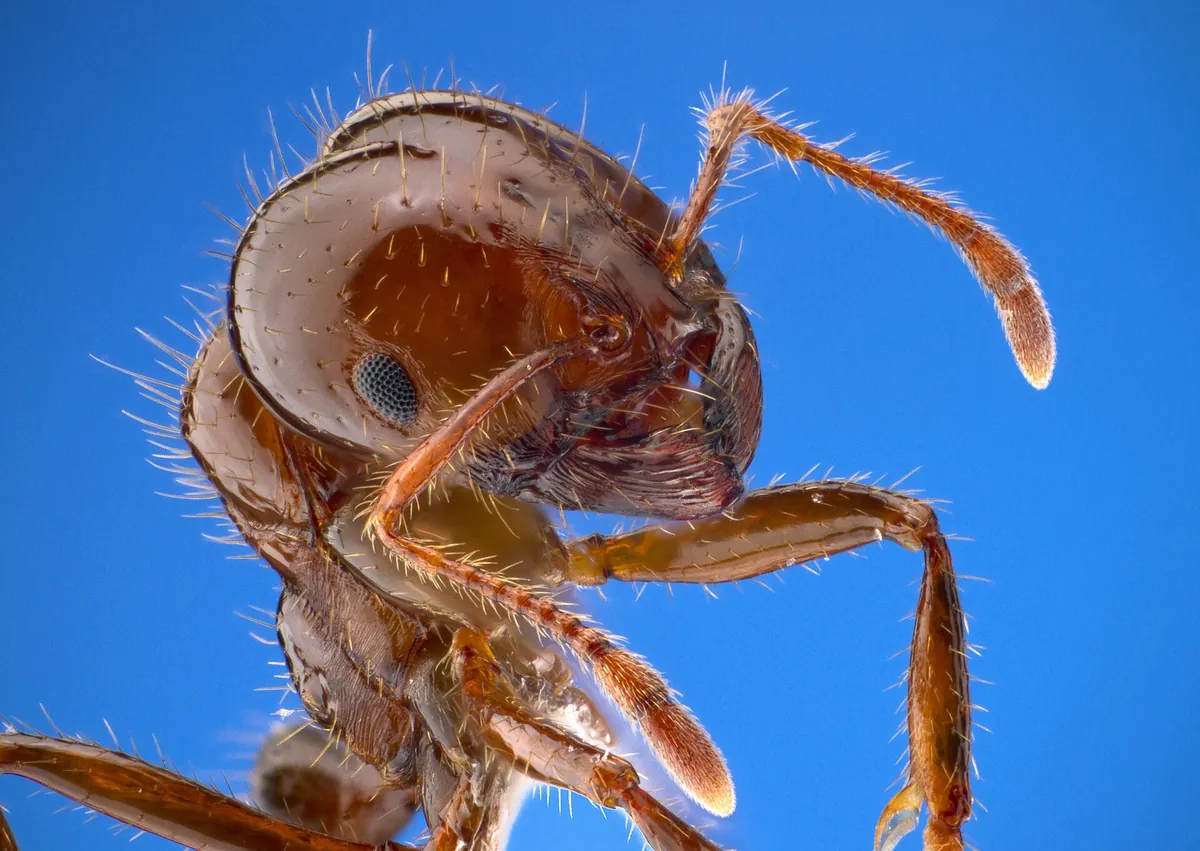


- The ants. Workers are aggressive, reddish brown to black, and ⅛ to ¼ inch long.2 In the same colony you’ll find workers of many sizes, from 2.4 to 6 mm, usually red to brown with a darker abdomen.1
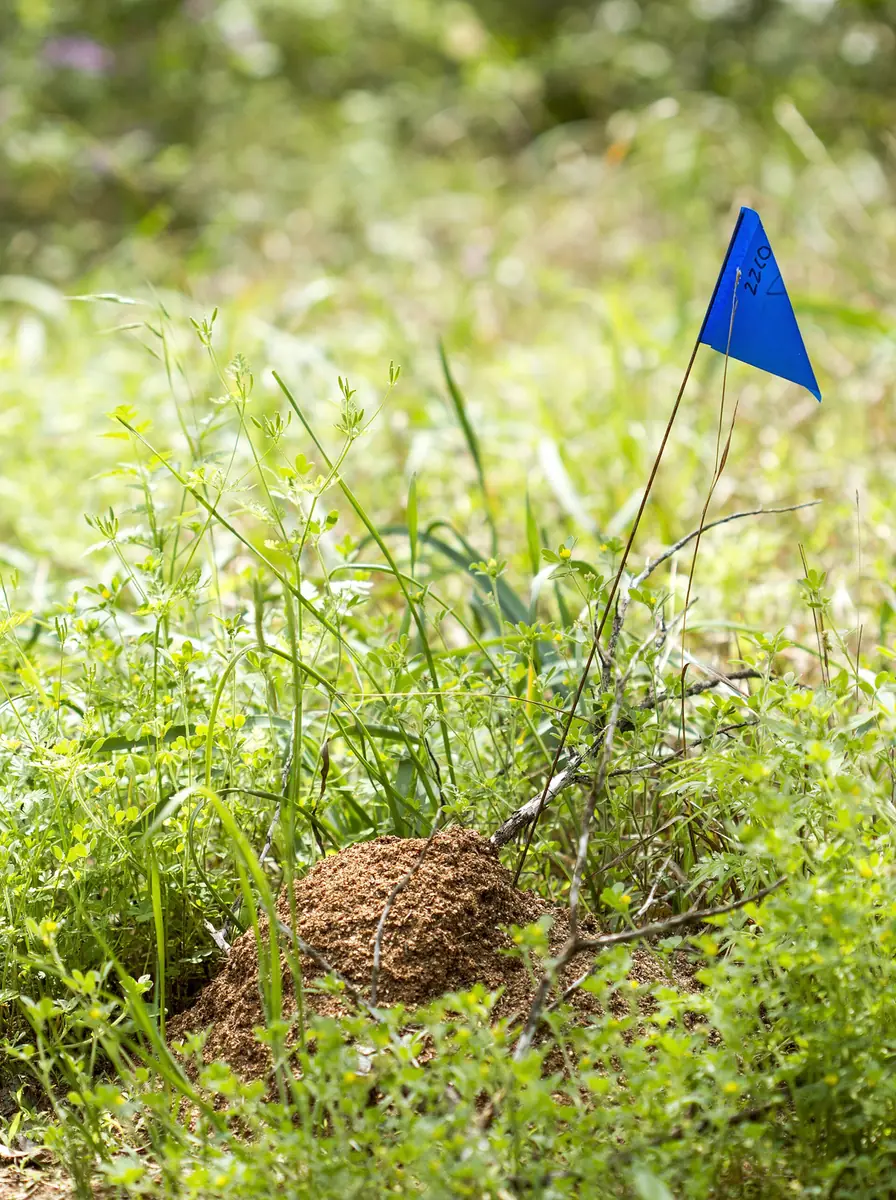
- The mound. Fire ants usually build visible dirt mounds. Because of Florida’s sandy soils, they may not make the big mounds you’d see in clay-soil states.2 Mounds also turn up around trees and stumps, under pavement and buildings, and occasionally indoors, and the ants sometimes nest inside electrical equipment and utility housings, where they can cause short circuits.2
- The behavior. Disturb a mound and many ants run out quickly and attack. The sting causes a burning pain, then a pustule and intense itching.2 UF/IFAS says a white pustule usually appears at the sting site the next day.1
- Imported or native? UF/IFAS says it’s important to tell them apart so you can choose the right control. Native fire ant mounds contain workers with square-shaped heads that are large for their bodies, which collect and mill seeds. Red imported fire ant colonies don’t have workers with heads that large.1
| Red imported fire ant | Native (tropical) fire ant | Ghost ant (for comparison) | |
|---|---|---|---|
| How common in Florida | The most notorious fire ant in the state1 | Much less common1 | Common in central and southern Florida3 |
| Workers | 2.4–6 mm, many sizes; red to brown with a darker abdomen1 | Includes workers with square, oversized heads that mill seeds1 | 1.3–1.5 mm, one size; dark head and thorax, pale abdomen and legs3 |
| Nest | Soil mounds in lawns and landscapes, flatter in sandy soil2 | Mounds1 | Small, shifting nests outdoors or indoors, including wall voids and potted plants3 |
Why fire ant stings matter
The effects of a sting can last up to 10 days, and a pustule can become infected if it’s broken open. Some people are allergic to fire ant stings, and those reactions can be severe.2 If someone has a severe reaction after being stung, treat it as an emergency and call 911. Leave pustules unbroken, and see a doctor about a sting that looks infected.
What doesn’t work
UF/IFAS lists several popular fixes that are not effective: club soda, grits, soap or wood ashes, shoveling mounds together, and spraying the foraging workers.2 Only about 20% of a colony is out foraging at any given time, so spraying the ants you see “is ineffective and unnecessarily adds pesticides to the environment.”2
UF/IFAS also does not recommend pouring boiling water or igniting flammable liquids on a mound. Even if they work, both are very dangerous to people and to the environment.1 Mechanical and electrical fire ant devices are sold, but their effectiveness has not been documented.1
The bait-first plan
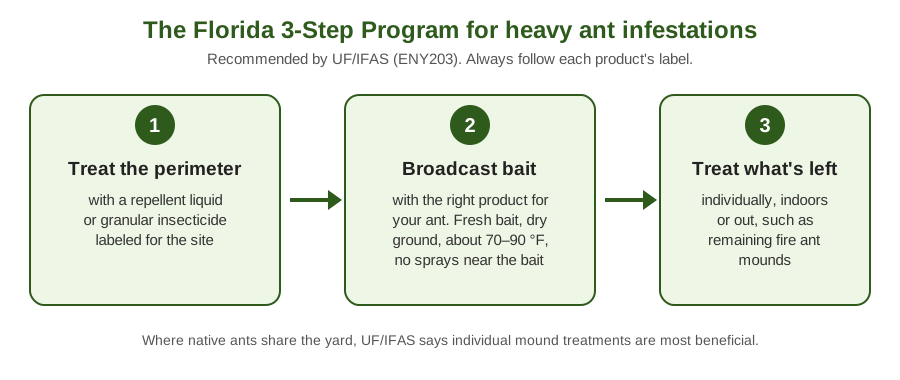
UF/IFAS says baits are slower acting but more effective than drenching, dusting or fumigating a mound, because the workers carry the bait home and feed it to the queen and brood.1 Baits work because ants share food mouth to mouth, which spreads the toxicant through the whole colony, queen included.4 For an established problem, it recommends combining broadcast bait with individual mound treatments using bait.2
Step 1: Pick the right bait
- Use a product labeled for fire ants and for the way you’ll use it. UF/IFAS says most granular baits labeled for broadcast use are also labeled for individual mound treatments.4 Check the label for both before you buy.
- Know the two kinds of active ingredient. Some baits contain insect growth regulators, which mainly affect brood production and development. Others contain metabolic inhibitors, which kill foraging workers, brood and queen.4
- Expect an oil-based bait. Fire ants feed on grease and oil more than other ants do, which is why fire ant baits are often oil-based.2 Broadcast products are typically baits made of soybean oil and toxicant on a corn grit carrier.1
Step 2: Bait at the right time, the right way
UF/IFAS’s checklist for granular baits:4
- Use fresh bait. If it smells like rancid oil or stale potato chips, it’s spoiled, and ants are less likely to eat it.
- Wash your hands first so you don’t contaminate the bait, and don’t smoke while baiting, because nicotine contaminates it.
- Bait on a “picnic day,” about 70–90 °F, and not right before or after a drenching rain. Turn off irrigation for a few hours before and after.
- Bait after dew, rain or irrigation has dried. Water ruins most baits.
- Put bait where the ants are foraging. Fire ants forage day and night when air temperatures are between 70 and 90 °F, and workers travel more than 100 feet from the nest.2
- Don’t spray any insecticide around the bait. Sprays are repellent, and ants won’t eat contaminated bait.
- Store leftover bait in an airtight container in a cool, dry place, away from other pesticides.
Keep bait away from spots where small children can find it.4
Step 3: Treat the mounds that remain
After baiting, treat nuisance mounds individually. A small amount of bait sprinkled around a mound lets foragers carry it back to the colony.1 UF/IFAS notes that individual mound treatments are most beneficial when native ants share the area, while their big drawback is that you must find every mound.1 Drenches, surface dusts and mound injections are other options, but they may not reach a queen deep in the nest, so the colony can come back.1 Whatever you use, apply it exactly as the label directs.
Keep ants out of the house
Spot treatments can keep foraging ants from coming indoors, but they don’t solve the underlying problem. Doors and windows that seal tightly, and sealant at the points where ants get in, also help.2 UF/IFAS’s general ant guide adds a few prevention basics: store food in tight containers, reduce moisture from leaks and condensation, and clear away piles of old lumber, firewood and debris that fire ants and other ants can nest in.4
Spare the ants that help you
UF/IFAS says one of the best biological controls for fire ants is other native, non-pest ants, so it’s important to use control methods that won’t kill all ants.2 The USDA has also released phorid flies, which parasitize fire ants. Three species have become widely established and spread beyond their release sites.2 That’s one more reason to favor targeted bait over blanket sprays.
Pesticide label safety (EPA)
- Read the label first and follow it “to the letter,” including all precautions and restrictions. Use a product only for the pests listed and no more than it says: “Don’t think that twice the amount will do twice the job.”5
- Keep children, toys and pets out of the area until the product has dried or for as long as the label says.5
- Outdoors, don’t apply on windy or rainy days, and keep products from drifting or running off into gardens, pools or a neighbor’s yard.5
- Keep the Poison Control number handy: 1-800-222-1222.5
When to call a pro
If fire ants are nesting in electrical equipment, utility boxes or the walls of your home, or keep coming back after a full bait program, a licensed company may be the safer choice. In Florida, licensed pest control businesses hold an FDACS license whose number begins with “JB,” and you can check it online or by calling FDACS at (850) 617-7997.6 Your county UF/IFAS Extension office can also help you decide which method fits your yard.2
UF/IFAS Featured Creatures, EENY-195 / IN352: Red Imported Fire Ant, Solenopsis invicta (Collins & Scheffrahn; revised November 2013, reviewed May 2020; opened Nov 16, 2026). Covers Florida’s two fire ant species; worker size and color; mounds and stings; telling imported from native fire ants; individual mound treatment methods (drenches, dusts, injections, baits, mechanical devices, home remedies); and broadcast bait products. ↩︎ ↩︎ ↩︎ ↩︎ ↩︎ ↩︎ ↩︎ ↩︎ ↩︎ ↩︎ ↩︎ ↩︎ ↩︎ ↩︎ ↩︎ ↩︎
UF/IFAS Gardening Solutions: Fire Ants (opened Nov 16, 2026). Covers appearance; stings and allergic reactions; mounds in sandy soil and where nests occur; oil-based baits; foraging distance and temperatures; ineffective methods and the 20% foraging figure; combining broadcast and mound baiting; exclusion; native ants and phorid flies; reinfestation; and contacting your county Extension office. ↩︎ ↩︎ ↩︎ ↩︎ ↩︎ ↩︎ ↩︎ ↩︎ ↩︎ ↩︎ ↩︎ ↩︎ ↩︎ ↩︎ ↩︎ ↩︎
UF/IFAS Featured Creatures, EENY310 / IN532: Ghost Ant, Tapinoma melanocephalum (revised February 2022, reviewed 02/2025; opened Nov 16, 2026). Covers worker size and color, pest status in Florida and nesting sites. ↩︎ ↩︎ ↩︎
UF/IFAS Extension, ENY203 / IG080: Ants (Koehler, Vazquez & Pereira; reviewed 02/2025; opened Nov 16, 2026). Covers how baits reach the queen; bait types; granular broadcast and mound labeling; the baiting checklist; not spraying near baits; keeping bait from small children; ant prevention; and the Florida 3-Step Program. ↩︎ ↩︎ ↩︎ ↩︎ ↩︎ ↩︎
U.S. EPA, Pesticide Safety Tips (opened Nov 16, 2026). Covers following the label, amounts, keeping children and pets away, wind, rain and drift, and Poison Control at 1-800-222-1222. ↩︎ ↩︎ ↩︎ ↩︎
FDACS, “How do I know if a pest control company is licensed?” (opened Nov 15, 2026). Covers JB license numbers and online or phone verification at (850) 617-7997. ↩︎